Research, Evidence, and the Path from Learning to Application
From Concept to Evidence
Integrated STEAM is not just an educational idea. It is a model supported by research, tested in real systems, and aligned with how students learn and how industries operate.
Across the United States, we continue to face a fundamental challenge. Students are learning science, math, and technology, but too many are not developing the ability to apply that knowledge in meaningful ways.
At the same time, employers are increasingly looking for individuals who can solve problems, communicate effectively, work across disciplines, and function within real systems.
This gap between knowledge and application is one of the defining issues in modern education. And integrated STEAM is designed to address it.
What Research Shows
A 2019 peer-reviewed study that examines South Korea’s national Integrated STEAM initiative provides one of the most comprehensive looks at how this model performs at scale. The findings are both clear and instructive.
STEAM Improves Learning and Engagement
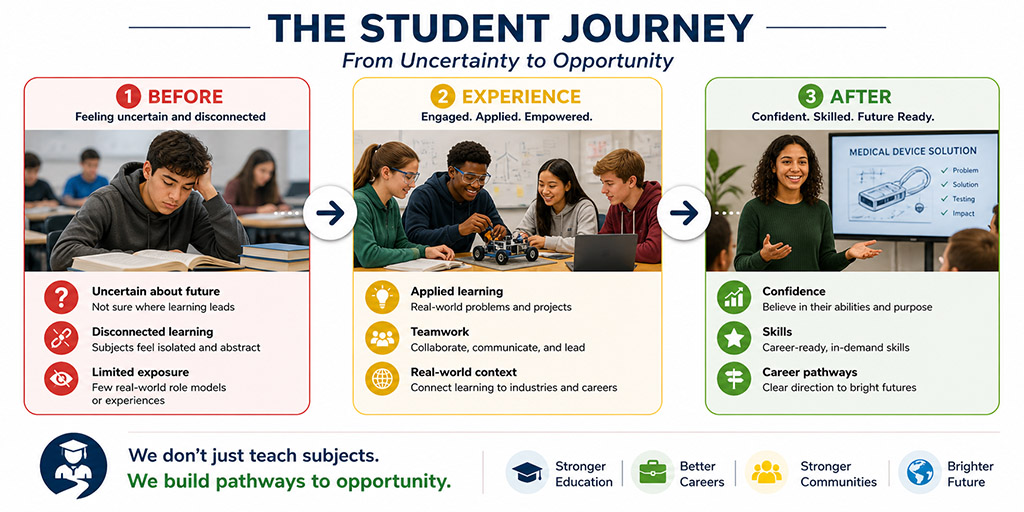
Students participating in STEAM programs showed improvements in both cognitive outcomes (academic performance) and affective outcomes of engagement, motivation, and confidence.
Importantly, the strongest gains were in the affective domain, or how students feel about learning. This matters.
Because students who are engaged persist longer, take on challenges, and begin to see themselves in future roles.
Learning Happens Through Application
The study highlights that effective STEAM programs are built around real-world problems, interdisciplinary thinking, and design-based learning.
Students are not just absorbing information. They are applying concepts, testing ideas, solving problems, and working in teams.
This aligns with what we know about learning, that knowledge becomes durable when it is used.
Development of Real-World Skills
In the study, STEAM programs were shown to improve students’ problem-solving ability, communication, collaboration, creativity, and self-directed learning
These are not secondary outcomes; they are the core competencies required in modern professional environments.
Long-Term Impact
One of the most compelling findings is that the effects of STEAM extend beyond the classroom.
Students who experienced STEAM programs reported stronger performance in college, demonstrated greater confidence in team-based work, showed increased ability to manage complex tasks, and indicated that STEAM influenced their career choices.
In other words, it shows that STEAM doesn’t just improve school performance, it shapes future pathways.
Scale and Adoption
Within a relatively short period, STEAM was adopted across a significant portion of South Korea’s education system, with many schools integrating STEAM into regular instruction.
This demonstrates that the model is not theoretical. It can be implemented at scale and sustained with the right support structures.
Why This Matters for Integrated STEAM
The implications of this research are directly aligned with the goals of Integrated STEAM.
First, it confirms that expanding beyond traditional STEM is necessary. The inclusion of the “A” for arts, communication, and human-centered thinking, is not optional. It is essential for developing well-rounded, capable individuals.
Second, it reinforces that how students learn matters as much as what they learn. Memorization alone does not produce capability. Application does.
And third, it validates a shift toward problem-based learning and real-world context.
These are not educational trends; they are requirements for preparing students for modern environments.
Bridging the Gap
One of the most important insights from this body of research is the recognition of a persistent gap where students may leave school with knowledge but without the ability to apply it effectively.
Integrated STEAM addresses this directly by creating learning environments where knowledge is used, skills are practiced, and thinking is developed through experience. This is where education transitions from information delivery to capability development.
A Model for the Future
Integrated STEAM represents a broader shift in education, from isolated subjects to connected systems; from passive learning to active engagement; from short-term retention to long-term capability; and from classroom exercises to real-world application.
Closing Perspective
The research is clear that when students are given the opportunity to engage with meaningful problems, apply knowledge across disciplines, work collaboratively, and build solutions.
They do more than learn. They develop the ability to think, to adapt, and to succeed. And that is the goal of education.
Integrated STEAM is not simply about improving instruction. It is about creating pathways from learning to doing, and from potential to opportunity.